Tuesday, August 17, 2021

Arthro-Pod EP 94: Talking Ants in August


In this episode we talked about ants! 

 Just a note, the Arthro-pod team had a pre-chat and practiced gratitude before getting into the ants, so if you want to bypass our personal updates, forward to about the 10-minute mark.  

 Some of the things we talked about topics like classification of ants, ants and communism, ants as pests, ants as aphid farmers, ants as beneficial insects, keeping ants as pets, the importance of identifying ants, how baiting works, and how to manage the ants thoughtfully and creatively in your urban landscape.  

Field ant carrying an asparagus beetle larva away. Photo by Jody Green, Nebraska Extension.

 Some of the ants we mention include Eastern black carpenter ants, small carpenter ants, acrobat ants, citronella ants, pavement ants, odorous house ants, Argentine ants, fire ants, and the extinct hell ants.  

Citronella ants can be a common sight in and around the home. They really do smell like citronella! Photo by Jody Green, Nebraska Extension


Show notes

We love ants and could have gone on for many episodes, but if you want to know more about ants, check out some of the resources we enjoy.  

AntWeb: https://www.antweb.org  

Ants of North America: A guide to the Genera:   

 Urban Ants of North America and Europe:  


There are many ant bait options on the market if you are looking to manage ants in and around the home. Photo by Jody Green, Nebraska Extension

Universities studying ants:  

Lucky Lab at University of Florida: https://andrealucky.com/  

Moreau Lab at Cornell University: https://www.moreaulab.entomology.cornell.edu/  

Ant Photos by Alexander Wild: https://www.alexanderwild.com/Ants  

Pavement ants engaged in a battle over territory. Who will win this particular sidewalk?! Photo by Jody Green, Nebraska Extension. 

Questions? Comments? 
Follow the show on Twitter @Arthro_Podshow

Follow the hosts on Twitter @bugmanjon, @JodyBugsmeUNL, and @MSkvarla36

Get the show through Apple Podcasts!

Subscribe to our feed on Feedburner!  


We're also on Stitcher!

This episode is freely available on archive.org and is licensed under Creative Commons: By Attribution 3.0. http://creativecommons.org/licenses/by/3.0/


Beginning/ending theme: "There It Is" by Kevin MacLeod (incompetech.com) Licensed under Creative Commons: By Attribution 3.0

Friday, July 30, 2021

Arthro-Pod EP 93: Insects vs. Napoleon Pt. 5 RUSSIA

In this penultimate episode of Arthro-Pod's 6 part series on the history of insects defeating Napoleon, we travel to Russia! Over the last four episodes, we’ve discussed the French Revolution and Napoleon’s rise to power, the French invasion of Egypt and their encounter with plague, and the Haitian Revolution and crushing defeats the British and French faced due in large part to yellow fever. 

Now, hear this one on the effects of typhus on Emperor Napoleon's campaigns near Russia and how he was thwarted by bugs and perhaps a little hubris!


Napoleon leads his troops during the Battle of Austerlitz, which is often regarded as the finest military victory of his career. "The Battle of Austerlitz, 2nd December 1805", 1810, by François Gérard. Via wikimedia, in the public domain.


Napoleon reviews his troops before the Battle of Jena. "Bataille d'Iéna. 14 octobre 1806", 1836, by Jorace Vernet. Via wikimedia, in the public domain.

Execution of Spanish resistance by French forces during the Peninsular War. "The Third of May 1808", 1810, by Francisco Goya. Via wikimedia, in the public domain.

Napoleon as he appeared in 1812 before his defeat in Russia. "The Emperor Napoleon in His Study at the Tuileries ", 1812, by Jacques-Louis David. Via wikimedia, in the public domain.

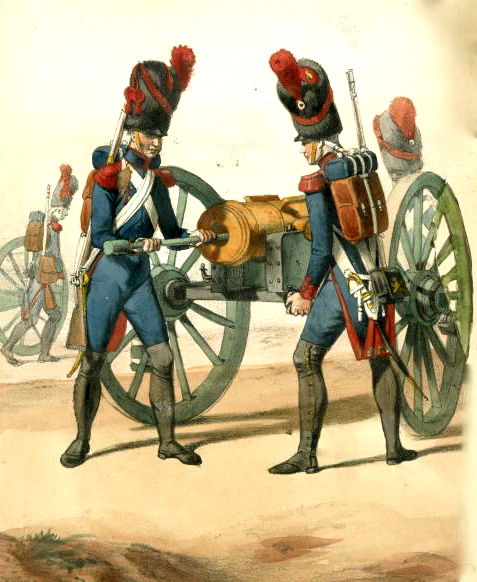
Heavy 12 pound cannon being serviced by two French Guard Foot. Artist unknown, 1808. Via wikimedia, in the public domain.

The French Empire  at it's greatest extent in 1812. Dark green areas were under direct control of France while light green areas were client states. By TRAJAN 117, via wikimedia, used under a CC BY-SA 3.0 license.

"Napoleon's retreat from Moscow", 1851, by Adolph Northen. Via wikimedia, in the public domain.

Retreat of the French Grand Army from Moscow, intercepted by Russian Cossack, 1812. 1813, by Edwd Orm. Via wikimedia, in the public domain.

Marshal Michel Ney, who begged Napoleon to commit the Imperial Guard during the Battle of Borodino and saved the western bridgehead, and so Napoleon and what remained of the French army, during the Battle of Berezina. "Marshal Michel Ney, duc d'Elchingen, prince de la Moskova", circa 1805, by François Gérard. Via wikimedia, in the public domain.

Attrition in the French Grande Armeé during the 1812 invasion of Russia. While the popular focus is often on the death and privation during the winter retreat, the chart clearly shows how the army was severely weakened even before reaching Moscow. Width of the colored areas the chart correspond to troop strength (1 mm = 10,000 troops). Geographic distance is shown by the scale in the center right ("lieues communes de France" = common French league) =  4444 m  or 2.75 miles). Temperatures (in Réaumur scale) on the bottom of the chart correspond to the black line of retreat. (multiply Réaumur temperatures by 1¼ to get Celsius, e.g. -19 °R at Smolensk = -23.75 °C = -10.75 °F). By Charles Minard, 1869. Via wikimedia, in the public domain.

Human louse, the vector of epidemic typhus and trench fever. Photo by Gilles San Martin. Via wikimedia, used under a CC BY-SA 2.0 license.

Macular rash caused by epidemic typhus. Illustration by George Jochmann, 1914. Via wikimedia, used under a CC BY-SA 4.0 license.


Questions? Comments? 
Follow the show on Twitter @Arthro_Podshow

Follow the hosts on Twitter @bugmanjon, @JodyBugsmeUNL, and @MSkvarla36

Get the show through Apple Podcasts!

Subscribe to our feed on Feedburner!  


We're also on Stitcher!

This episode is freely available on archive.org and is licensed under Creative Commons: By Attribution 3.0. http://creativecommons.org/licenses/by/3.0/

Friday, July 23, 2021

Arthro-Pod Episode 92: Three Hosts in an Arthro-Pod


Today's episode is a special treat! The Arthro-Pod crew was invited to give an Early Career Professional seminar for the Entomological Society of America and we got to record it as an episode! So, tune in to hear us get interviewed for a slight change of pace, as Dr. Karen Poh of Penn State hosts us. It was a lot of fun and we hope that people are inspired to make their own podcasts or find new ways of contributing to science communication!


If you would like to see our previous webinar from the ESA Share Fair on how to start your own podcast here is a YouTube link
 https://youtu.be/wcX2YmaNOdg


Questions? Comments? 
Follow the show on Twitter @Arthro_Podshow

Follow the hosts on Twitter @bugmanjon, @JodyBugsmeUNL, and @MSkvarla36

Get the show through Apple Podcasts!

Subscribe to our feed on Feedburner!  


We're also on Stitcher!

This episode is freely available on archive.org and is licensed under Creative Commons: By Attribution 3.0. http://creativecommons.org/licenses/by/3.0/


Beginning/ending theme: "There It Is" by Kevin MacLeod (incompetech.com) Licensed under Creative Commons: By Attribution 3.0

Wednesday, June 30, 2021

Arthro-Pod EP 91: The Haitian Revolution and Insects Pt. 2

In this episode, we wrap up the story of the Haitian Revolution. Toussaint Louverture consolidated power in the colony and drafted a new Constitution, in response to which Napoleon sent a massive French to bring Saint-Domingue back under French control. Much like the British before them, the French troops were decimated by yellow fever and so were not strong enough to put down the revolt that broke out when it was discovered that Napoleon planned to reimpose slavery in the colony. 

We also discuss yellow fever virus, including the disease it causes, how it came to the Americas, and the mosquito that vectors it.


Engraving of Toussaint Louverture by J. Barry, published by James Cundee, after M. Rainsford line engraving, published circa 1800-1825. Via  the National Portrait Gallery (NPG D15719), used under a CC BY-NC-ND 3.0 license.


Portrait of General Gabriel-Marie-Théodore-Joseph, comte d'Hédouville by Jean-Baptiste Paulin Guérin (1835). Via wikimedia, in the public domain. 


Sketch of General Hédouville by an unknown artist. Via wikimedia, in the public domain


Sketch of André Rigaud by an unknown artist. Via wikimedia, in the public domain.


The Constitution of Year VIII, which stated that the colonies would be ruled by "special laws". Via wikimedia, in the public domain.


The Constitution of Saint-Domingue (1801), which installed Toussaint Louverture as governor for life. Via wikimedia, in the public domain.


Engraving of General Charles Victoire Emmanuel Leclerc by Jean-Baptiste Réville in "France militaire: histoire des armées françaises de terre et de mer de 1792 à 1837" (1838) by A. Hugo. Via wikimedia, in the public domain.


Painting of General Leclerc by François Kinson (1804). Via wikimedia, in the public domain.


Polish legionaries in Saint Domingue, by January Suchodolski (1854). Via wikimedia, in the public domain.


Public mural of Jean Jaques Dessalines in Port-au-Prince. Via wikimedia, in the public domain.


Engraving of Jean Jaques Dessalines in "Dictionnaire géographique et administratif universel d'Haïti" (1892) by S. Rouzier. Original held and digitized by the British Library. Via wikimedia, in the public domain.

 Portrait of Henry I, King of Haiti (Henri Chrisophe), probably by Johann Gottfried Eiffe (1817). Via wikimedia, in the public domain.

 Engraving of Henri Christophe in "Dictionnaire géographique et administratif universel d'Haïti" (1892) by S. Rouzier. Original held and digitized by the British Library. Via wikimedia, in the public domain.

Yellow fever mosquito (Aedes aegypti), the vector of yellow fever virus. Photograph by Muhammad Mahdi Karim, via wikimedia, used under a GNU Free Documentation License, Version 1.2.

Yellow fever mosquito feeding on a human. Photograph by James Gathany, CDC. Via wikimedia, in the public domain.

Transmission cycles of yellow fever. Graphic via the CDC, in the public domain.

Illustration of a man sick with yellow fever, from the broadside "'Death of Aurelio Caballero due to yellow fever in Veracruz" (1892) by José Guadalupe Posada. Via wikimedia, in the public domain.
 
The Louisiana Territory, which Napoleon sold to the United States after he lost the colony of Saint-Domingue and abandoned his plans of a Caribbean-based empire. Graphic by William Morris via Wikimedia, used under a CC BY-SA 4.0 license.

 
Questions? Comments? 
Follow the show on Twitter @Arthro_Podshow

Follow the hosts on Twitter @bugmanjon, @JodyBugsmeUNL, and @MSkvarla36

Get the show through Apple Podcasts!

Subscribe to our feed on Feedburner!  


We're also on Stitcher!

This episode is freely available on archive.org and is licensed under Creative Commons: By Attribution 3.0. http://creativecommons.org/licenses/by/3.0/


Beginning/ending theme: "There It Is" by Kevin MacLeod (incompetech.com) Licensed under Creative Commons: By Attribution 3.0


Thursday, June 17, 2021

Arthro-Pod EP 90: Meet Dr. Ana Maria Velez Arango!


Jody interviewed Dr. Ana Maria Velez Arango, who is a small but mighty assistant professor in the Department of Entomology at the University of Nebraska-Lincoln. Ana discusses her background, growing up as a young naturalist in Colombia and her journey as an undergraduate in majoring into biology to becoming known for her work in molecular biology, insect toxicology, insecticide resistance, RNAi technology and how it relates to insect behavior, physiology, and population genetics. Aside from many professional endeavors, Ana is an advocate for students, women scientists, mental health and wellness, diversity and inclusion, professional development for early career professionals, and rescue dogs. 

Dr. Ana Velez and her dogs, Berdie and Peepers


Images to accompany the time when Ana felt like a Mad Scientist when she knocked down one gene to turn western corn rootworm larvae into hunchbacks

Show Notes 

The Velez Arango Lab 

https://www.veleztoxicologylab.com/ 

Dr. Ana Maria Velez 

https://entomology.unl.edu/dr-ana-maria-velez 


Questions? Comments? 
Follow the show on Twitter @Arthro_Podshow

Follow the hosts on Twitter @bugmanjon, @JodyBugsmeUNL, and @MSkvarla36

Get the show through Apple Podcasts!

Subscribe to our feed on Feedburner!  


We're also on Stitcher!

This episode is freely available on archive.org and is licensed under Creative Commons: By Attribution 3.0. http://creativecommons.org/licenses/by/3.0/


Beginning/ending theme: "There It Is" by Kevin MacLeod (incompetech.com) Licensed under Creative Commons: By Attribution 3.0


Wednesday, June 2, 2021

Arthro-Pod EP 89: The Haitian Revolution (Part 3 of the Napoleon vs Insects Series)


In this episode we discuss the stress factors in the French sugar colony of Saint-Domingue that led to the Haitian revolution, including slavery and the racial apartheid system; how the Haitian revolution was intertwined with and influenced by the French Revolution; the decimation of British troops by yellow fever and the failed British invasion of Saint-Domingue; and the rise of Toussaint Louverture, whose actions would provoke Napoleon into invading Saint-Domingue.

The island of Hispaniola is dominated by tall, east-west running mountains.

Map of the provinces of French Saint-Dominuge, showing the relative locations of the North, West, and South.

"Napoleon Bonaparte in the coup d'état of 18 Brumaire in Saint-Cloud" by François Bouchot

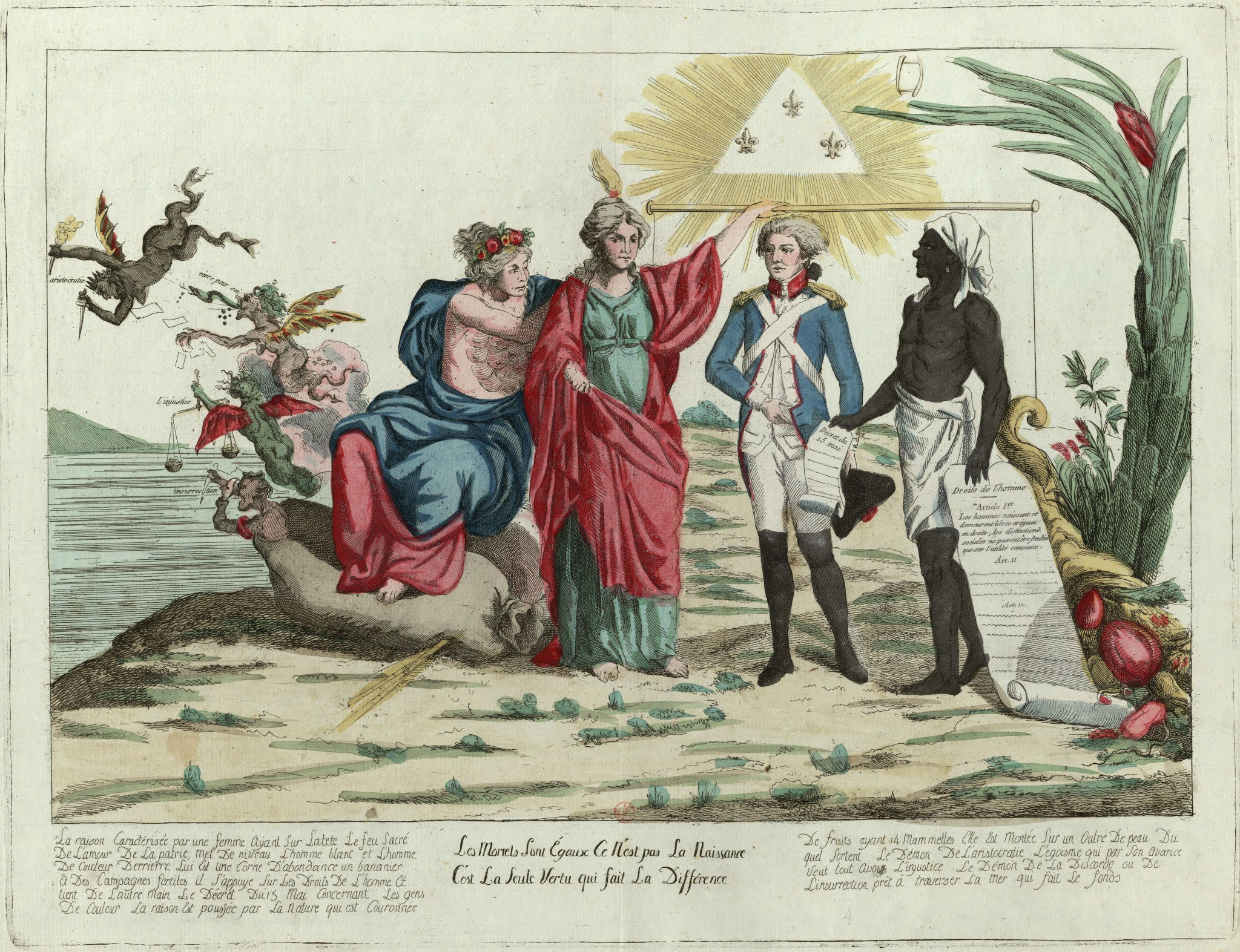
"Mortals are equal, it is not birth, but virtue alone that makes the difference". There was an abolotionist movement among the French aristocracy prior to the French and Haitian Revolutions, as illustrated by this illustration.

"Burning of the Plaine du Cap - Massacre of whites by the blacks". Most of the contemporary illustrations of the Haitian Revolution were produced by  Europeans and show Black slaves murdering White planters. While such atrocaties happened, such skewed presentations that did not include the brutality the former slaves faced, helped skew public opinion outside of Saint Domingue against the slaves. 

Illustration of jungle fighting between French troops and Black former slaves. "Saint Domingue: Capture of Ravine-à-Couleuvres"

"Portrait of Léger-Félicité Sonthonax (1763-1813)" by an unknown painter. 

"Toussaint Louverture" by Alexandre-François-Louis, comte de Girardin, painted posthumously.


Questions? Comments? 
Follow the show on Twitter @Arthro_Podshow

Follow the hosts on Twitter @bugmanjon, @JodyBugsmeUNL, and @MSkvarla36

Get the show through Apple Podcasts!

Subscribe to our feed on Feedburner!  


We're also on Stitcher!

This episode is freely available on archive.org and is licensed under Creative Commons: By Attribution 3.0. http://creativecommons.org/licenses/by/3.0/


Beginning/ending theme: "There It Is" by Kevin MacLeod (incompetech.com) Licensed under Creative Commons: By Attribution 3.0


Wednesday, May 12, 2021

Arthro-Pod EP 88: Periodical cicada BROOD X Quiz Bowl!

 The Arthro-Pod crew is super excited about the emergence of the periodical cicadas known as Brood X this year! To celebrate Jody created a quiz competition for Mike and Jonathan to face off through! The questions can be found on Kahoot if you would like to give it a shot! Just look for the Periodical Cicada Quiz with 26 questions. Tune in to learn about the cicadas coming out this year and get excited to go find them!

The cicadas are here! Photo by Daniel Herms, The Ohio State University, Bugwood.org 

Show notes

Periodical Cicadas the Brood X Edition by Gene Kritsky
Check out this Scientific American article that talks about the important contributions of 
Margaretta Hare Morris to our understanding of cicadas

The University of Connecticut houses a lot of great info on the distribution of cicadas

o   https://cicadas.uconn.edu/broods/ 

Cicada Mania is a resource everyone should check out if they are interested in these awesome creatures. In particular look at their pages on cicada biology/natural history and discussions on the broods

o   https://www.cicadamania.com/cicadas/how-many-kinds-of-cicadas-are-there/

Finally, please consider downloading and using the Cicada Safari app if you get to go out and look for these screaming teenage bugs!

Questions? Comments? 
Follow the show on Twitter @Arthro_Podshow

Follow the hosts on Twitter @bugmanjon, @JodyBugsmeUNL, and @MSkvarla36

Get the show through Apple Podcasts!

Subscribe to our feed on Feedburner!  


We're also on Stitcher!

This episode is freely available on archive.org and is licensed under Creative Commons: By Attribution 3.0. http://creativecommons.org/licenses/by/3.0/


Beginning/ending theme: "There It Is" by Kevin MacLeod (incompetech.com) Licensed under Creative Commons: By Attribution 3.0